
Zoho CRM and HubSpot: The Real Differences in 2026
All prices in this article are in USD and were verified against vendor pricing pages in June 2026. Software pricing changes frequently — always check the vendor’s website for current pricing before making a purchasing decision.
⚡ Quick Verdict
HubSpot — Best for teams that want fast setup, polished design and native marketing tools in one platform. Worth the premium if budget allows.
Zoho CRM — Best for budget-conscious businesses that need deep customisation and don’t mind investing time in configuration. Exceptional value at every tier.
HubSpot and Zoho CRM are two of the most searched CRM platforms in 2026 — and for good reason. Both are genuinely excellent products used by hundreds of thousands of businesses worldwide. But they were built with different philosophies, different price points and different types of teams in mind.
This comparison presents both platforms honestly. We’ve used verified 2026 pricing and real user data to give you the clearest possible picture — without favouring either side.
📋 In This Article
Platform Overview
HubSpot was founded in 2006 as an inbound marketing platform and has evolved into a full business suite covering CRM, marketing, sales, customer service and content — all built around a unified contact record. Its philosophy is to make powerful tools accessible without requiring technical expertise.
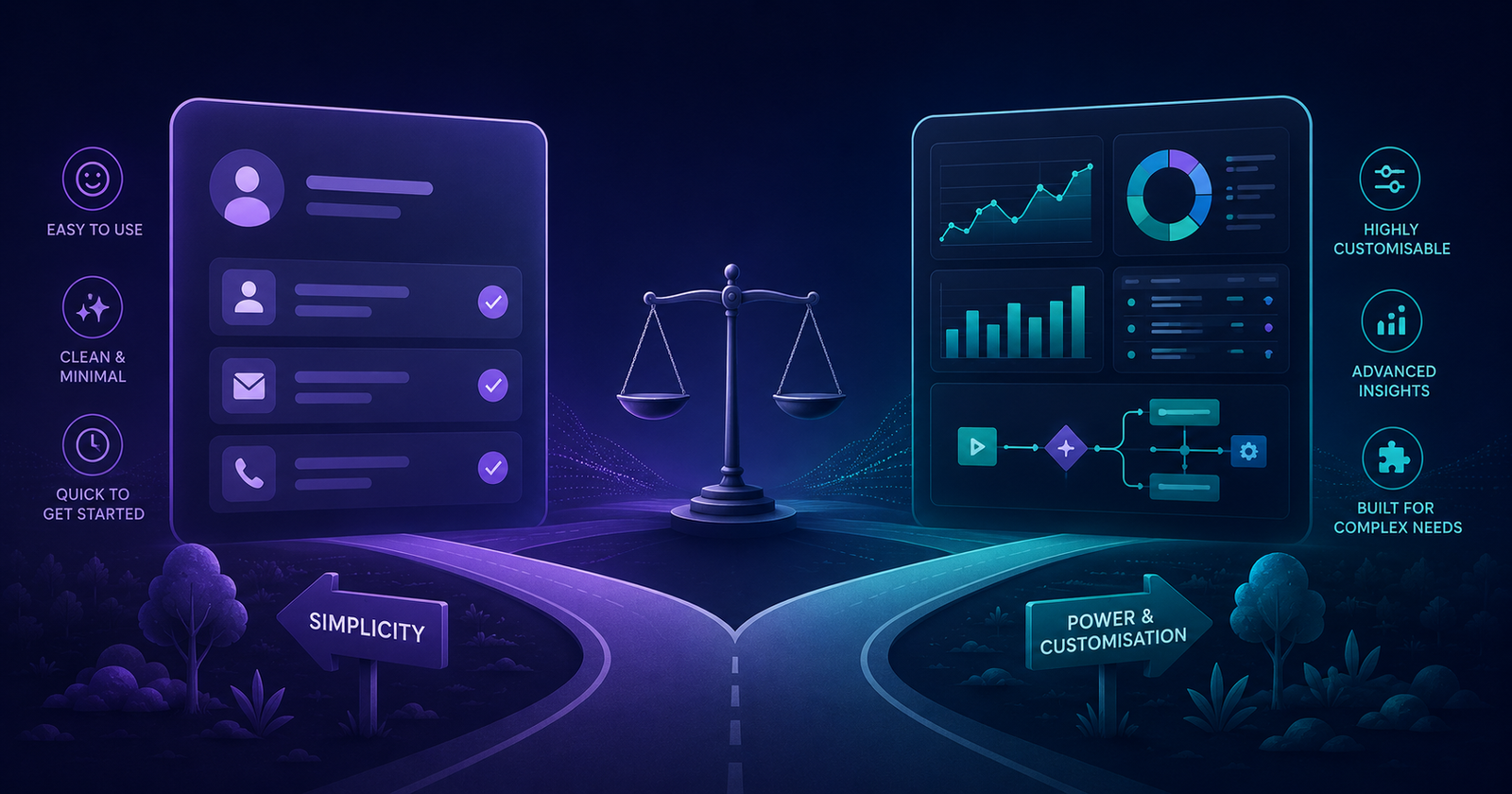
Zoho CRM was launched in 2005 by Zoho Corporation — a company that now operates over 45 integrated business applications. Where HubSpot prioritises simplicity and out-of-the-box usability, Zoho is engineered for deep customisation and cost efficiency. It’s built for businesses that want to shape the CRM around their specific workflow rather than adapting their workflow to the software.
| HubSpot | Zoho CRM | |
|---|---|---|
| Founded | 2006 | 2005 |
| Free plan | ✓ Generous — unlimited users | ✓ Up to 3 users |
| Starting price | $15/user/mo | $14/user/mo |
| Professional tier | From $890/mo | $23/user/mo |
| Ease of use (G2) | 8.7/10 | 8.3/10 |
| Customisation | Moderate | Extensive |
| Marketing tools | ✓ Native, all-in-one | Separate (Zoho Campaigns) |
| Onboarding fee | $3,000+ at Professional | None |
Pricing Comparison
Pricing is where the gap between HubSpot and Zoho CRM becomes most significant — particularly at higher tiers.
HubSpot Pricing (2026)
Free: Unlimited users with core CRM, contact management, email tracking, meeting scheduler, live chat and basic reporting. No automation included — the free plan is genuinely useful as a starting point.
Starter — $15/user/month (annual): Removes HubSpot branding, adds email automation and basic sequences.
Professional — from $890/month (annual, includes 3 seats): Full automation, advanced sequences, custom reporting and workflows. A mandatory $3,000 onboarding fee applies. This is where most growing teams land — and where costs jump significantly.
Enterprise — from $3,600/month: Advanced permissions, custom objects, predictive lead scoring and dedicated support. Mandatory onboarding fees of $6,000 or more.
Zoho CRM Pricing (2026)
Free: Up to 3 users, 5,000 records — a real working CRM for very small teams.
Standard — $14/user/month (annual): Workflow automation, custom modules, scoring rules and email insights.
Professional — $23/user/month (annual): Blueprint process management, SalesSignals, inventory management and Google Ads integration.
Enterprise — $40/user/month (annual): AI predictions via Zia, multi-user portals, advanced customisation and territory management.
Ultimate — $52/user/month (annual): Advanced analytics, enhanced storage and premium support.
💰 Real Cost Comparison — 5-Person Team at Professional Tier (2026)
HubSpot Professional: ~$25,800 in Year 1 (including $3,000 onboarding + $890/month base)
Zoho Professional: ~$1,380 per year ($115/month for 5 users)
Zoho costs approximately 20x less than HubSpot at the Professional tier for a 5-person team.
Features & Functionality
Both platforms cover the core CRM fundamentals well — contact management, deal pipelines, email integration, task management and reporting. The differences show up in depth, flexibility and what’s included at each price tier.
Where HubSpot Leads
Native all-in-one marketing suite. HubSpot includes email marketing, landing pages, forms, live chat, a blog tool and social media management natively in the same platform as the CRM. Everything shares a unified contact record — leads flow automatically from marketing to sales without integration work.
App marketplace. HubSpot’s App Marketplace offers over 2,000 integrations with 2.5 million active installations — one of the largest ecosystems of any CRM platform.
Support quality. G2 scores HubSpot’s support at 8.6/10 versus Zoho’s 7.4/10. HubSpot Academy — a free education platform covering CRM, marketing and sales — is widely regarded as the best free learning resource in the industry.
Where Zoho CRM Leads
Customisation depth. Zoho CRM offers custom modules, custom fields, custom page layouts, custom buttons and custom functions across all paid tiers — including Standard. HubSpot reserves meaningful customisation for Enterprise plans.
Lead scoring at lower tiers. Zoho includes lead scoring from the Standard plan at $14/user/month. HubSpot only unlocks lead scoring at Professional tier — which starts at $890/month.
No onboarding fees. Zoho charges no mandatory onboarding fees at any tier. HubSpot charges $3,000 at Professional and $6,000 at Enterprise — costs that significantly inflate the first-year price.
Integrated business suite. Zoho Corporation owns over 45 business applications — including Zoho Books, Zoho Desk, Zoho Campaigns, Zoho Projects and Zoho Analytics. Teams already using Zoho products benefit from native integrations without additional cost.
🏆 HubSpot Wins On
- Ease of use
- Native marketing tools
- App marketplace
- Support quality
- Free plan generosity
🏆 Zoho CRM Wins On
- Price at every tier
- Customisation depth
- No onboarding fees
- Lead scoring accessibility
- Integrated app suite
Ease of Use
This is the area where HubSpot has the clearest advantage. G2’s verified user ratings give HubSpot an ease-of-use score of 8.7/10 versus Zoho’s 8.3/10 — a gap that reflects a real difference in onboarding experience.
HubSpot is designed to be usable on day one. The interface is clean and modern with guided setup wizards that walk teams through each step. Most small teams achieve basic proficiency within one week. The design consistently earns praise from reviewers for its intuitive navigation and visual clarity.
Zoho CRM is not difficult to use — but the sheer volume of options can feel overwhelming initially. The main sidebar contains over 80 sections each with multiple sub-options. Basic adoption takes several days but realising the platform’s full capabilities typically requires two to four weeks of configuration. The payoff for that investment is a CRM that fits your specific workflow precisely rather than requiring you to adapt to the software’s assumptions.
For teams without dedicated technical staff or those needing fast deployment, HubSpot’s advantage here is meaningful. For teams with a technical resource who want maximum flexibility, the Zoho learning curve is a worthwhile investment.
AI Capabilities
Both platforms have invested heavily in AI in 2026 — though their implementations differ.
HubSpot Breeze AI is built across all hubs. It drafts follow-up emails, summarises meeting notes, flags duplicate contacts, suggests leads from existing data and helps sales representatives craft personalised messages. It’s genuinely accessible for non-technical users and doesn’t require configuration to start getting value.
Zoho Zia provides predictive sales insights, anomaly detection, lead scoring predictions, deal win probability and workflow suggestions. Zia is available from the Enterprise plan at $40/user/month. For teams that need AI-powered forecasting without paying HubSpot’s enterprise prices, Zoho’s AI capabilities at Enterprise tier represent strong value.
Support & Resources
HubSpot scores significantly higher on support quality — G2 rates it at 8.6/10 versus Zoho’s 7.4/10. HubSpot Academy is a world-class free education platform covering CRM, inbound marketing, sales and content. Phone support is available on Professional and Enterprise plans. Community forums are active and well-maintained.
Zoho CRM offers 24/5 support across paid plans with 24/7 support available on Ultimate tier. User reviews consistently note that support response times for non-premium users can be slow. However Zoho’s knowledge base and documentation are extensive and the product has a large community of users and implementation partners globally.
Who Should Choose Which
Choose HubSpot if you:
- Want to be up and running within days with minimal configuration
- Need marketing and sales tools natively connected in one platform
- Have budget for Professional tier and can absorb the onboarding fee
- Have a marketing-led growth model with inbound campaigns
- Value support quality and access to educational resources
- Have a team that needs a polished intuitive interface
Choose Zoho CRM if you:
- Are budget-conscious and want maximum features per dollar spent
- Have non-standard sales processes that need custom workflows
- Already use other Zoho products and want native integration
- Need lead scoring without paying enterprise prices
- Want no mandatory onboarding fees
- Have a technical resource who can handle initial configuration
⚠️ Watch out for HubSpot’s Professional tier costs: The $890/month base price for HubSpot Professional sounds manageable — but add the mandatory $3,000 onboarding fee and the first year cost for a 5-person team exceeds $25,000. Always model Year 1 total cost of ownership before committing.
Final Verdict
Both HubSpot and Zoho CRM are excellent platforms — the right choice genuinely depends on your priorities rather than one being objectively better than the other.
Choose HubSpot if speed of deployment, ease of use and native marketing-sales alignment are your priorities — and your budget can absorb the Professional tier costs. The platform’s polish, support quality and unified approach make it the better choice for teams that want to move fast without technical complexity.
Choose Zoho CRM if budget efficiency and customisation depth are your priorities. At $14/user/month for Standard and $23/user/month for Professional — with no onboarding fees — Zoho delivers enterprise-level functionality at a fraction of HubSpot’s Professional pricing. For budget-conscious small businesses with specific workflow requirements, Zoho’s value proposition is difficult to match.
The key question to ask yourself: Can your business absorb HubSpot Professional costs long term? If yes — HubSpot’s ease of use and marketing integration may justify the premium. If not — Zoho delivers comparable core CRM functionality at a price that won’t strain a small business budget.
🎯 Not Sure Which CRM Is Right for You?
Answer 5 quick questions about your business and get a personalised CRM recommendation based on your specific team size, budget and sales process. Free and instant.
Get my personalised recommendation →Free · Takes 60 seconds · No email required
Pricing figures in this article are based on publicly available 2026 pricing from HubSpot and Zoho. G2 scores sourced from verified user reviews. Actual costs may vary based on contract length, negotiation and add-ons. Always verify current pricing directly with the vendor before making a purchasing decision.